Typology: Blog
How to drive innovation in a corporate environment
Organisations are constantly under threat from change, from the emergence of new competitors, from sudden 180-degree shifts in consumer trends, from black swans or other factors that can turn their financial results ‘upside down’. This context, where there are no ‘blue oceans’, necessitates innovation ecosystems in which to constantly test and experiment with new solutions or products.
Fernando Vallejo
Services
Benefits

What had previously been confined to the Information Technology (IT) sector has now spread to all types of industry, proving crucial in highly competitive sectors such as food, retail, finance… and many others.
Innovation as a strategy for business growth
These ecosystems are physical spaces, but also processes, organisational models and, of course, cultural frameworks in which autonomy, freedom and tolerance for error are fundamental.
Creating the right environment to foster these working dynamics has been one of the most rewarding areas of focus for BICG in recent years.
The key factors in designing a suitable concept to encourage innovation are:
An activity-based office is also ideal for creating the optimal environment:
Innovation can take different forms depending on the type of business. Innovating with a food product, a financial service or a technological solution is not the same thing. The activities carried out around ideation, testing and experimentation take different forms: tastings, hands-on work, conceptual ideation, project monitoring, interaction with stakeholders… Depending on the needs, specific spatial solutions must be adopted, with a wide range of spatial typologies available within the office.
Fostering serendipity:
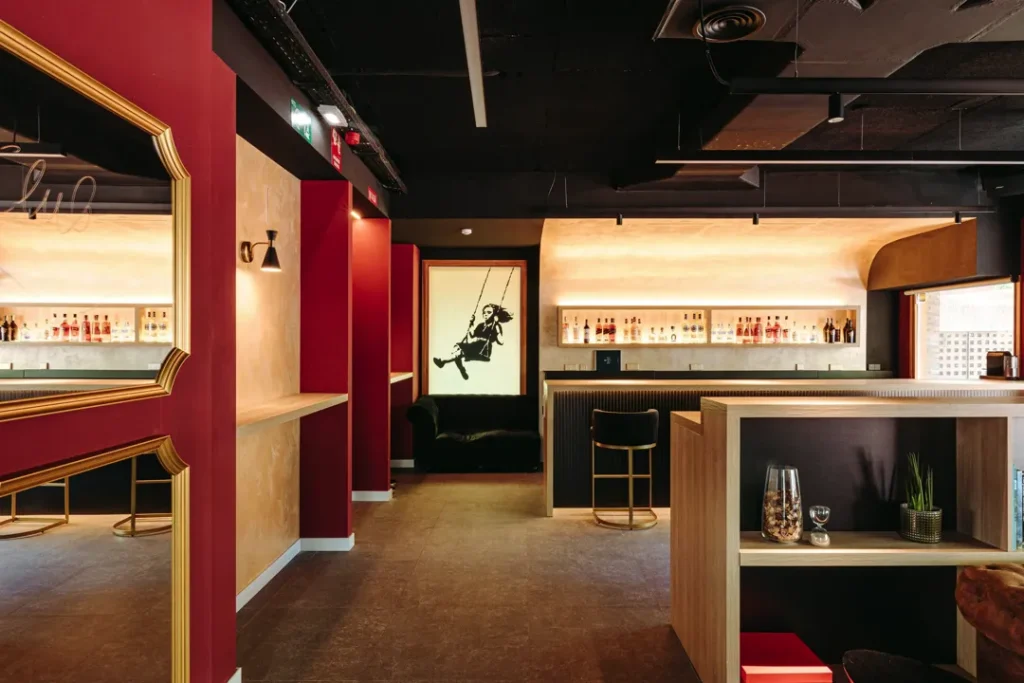
Providing spaces for exchange, meeting and serendipity, where ‘things happen’ that bring professionals closer together and increase their interaction spontaneously. To achieve this, it is essential to incorporate areas within the office space dedicated to meeting, relaxation and informal collaboration.
Using architecture as a strategy to modify behaviour:
It is known that the use of sinuous forms, furniture that encourages interaction, or access to nature and open spaces modifies the behaviour of those who inhabit that space, enhancing creative development compared to other physical environments. Using these elements, amongst others, provides professionals with a workspace designed to enhance their creativity. (McCoy, J. M., & Evans, G. W. (2002). The potential role of the physical environment in fostering creativity. Creativity Research Journal, 14(3-4), 409–426.
Aligning space and technology:
In this case, alignment does not always imply a high level of technological provision. Rather, we refer to having the technological tools that facilitate activities in those places where technology acts as a facilitator. We might find places where manual work and introspection are prioritised, eliminating other unnecessary technological stimuli. In any case, what matters is the strategic provision of technology and how easily it can be used and incorporated into the activities to be carried out.
Bringing spaces from other contexts into the office:
Innovation does not belong exclusively to the corporate sphere; in fact, I would go so far as to say that the most creative moments have possibly occurred in situations far removed from an office, whilst carrying out everyday activities such as socialising, running errands or spending time with family. Combining this factor with the hybridisation of spaces—where uses are increasingly intertwined—makes it advantageous to broaden the range of spaces, providing corporate centres with alternative locations that enrich activities and thus foster greater creativity and innovation among their professionals.
Innovation ecosystems extend beyond the office:
Thanks to flexible organisational models and technological tools, knowledge work is rarely tied to a specific workspace, which means that other places can largely emerge where activities can be carried out that also foster creativity and innovation. Providing the opportunity to go beyond the office is key to challenging the physical limits of ideation.
Aligning technology and physical spaces:
Above all, however, the success of a project of this kind lies not only in bringing together the more tangible aspects, but also in fostering a work culture and team organisation that enables innovation to flourish. There is little point in having an ideal space for fostering creative behaviour if the organisation’s culture does not encourage tolerance for error, uncertainty, collaborative work or professional autonomy. This is why at BICG we employ a methodology centred on the integration of disciplines, with multidisciplinary teams providing comprehensive advice on spaces, processes, technology, culture and change management.
You can find some of our most significant projects in this area in our success stories, such as Telefónica IoT, Mercadona Jarrods and ABB, amongst others.
Share
Related Projects

BEUMER – Beckum
View Project
BEUMER – Dortmund
View Project
INIBSA
View Project